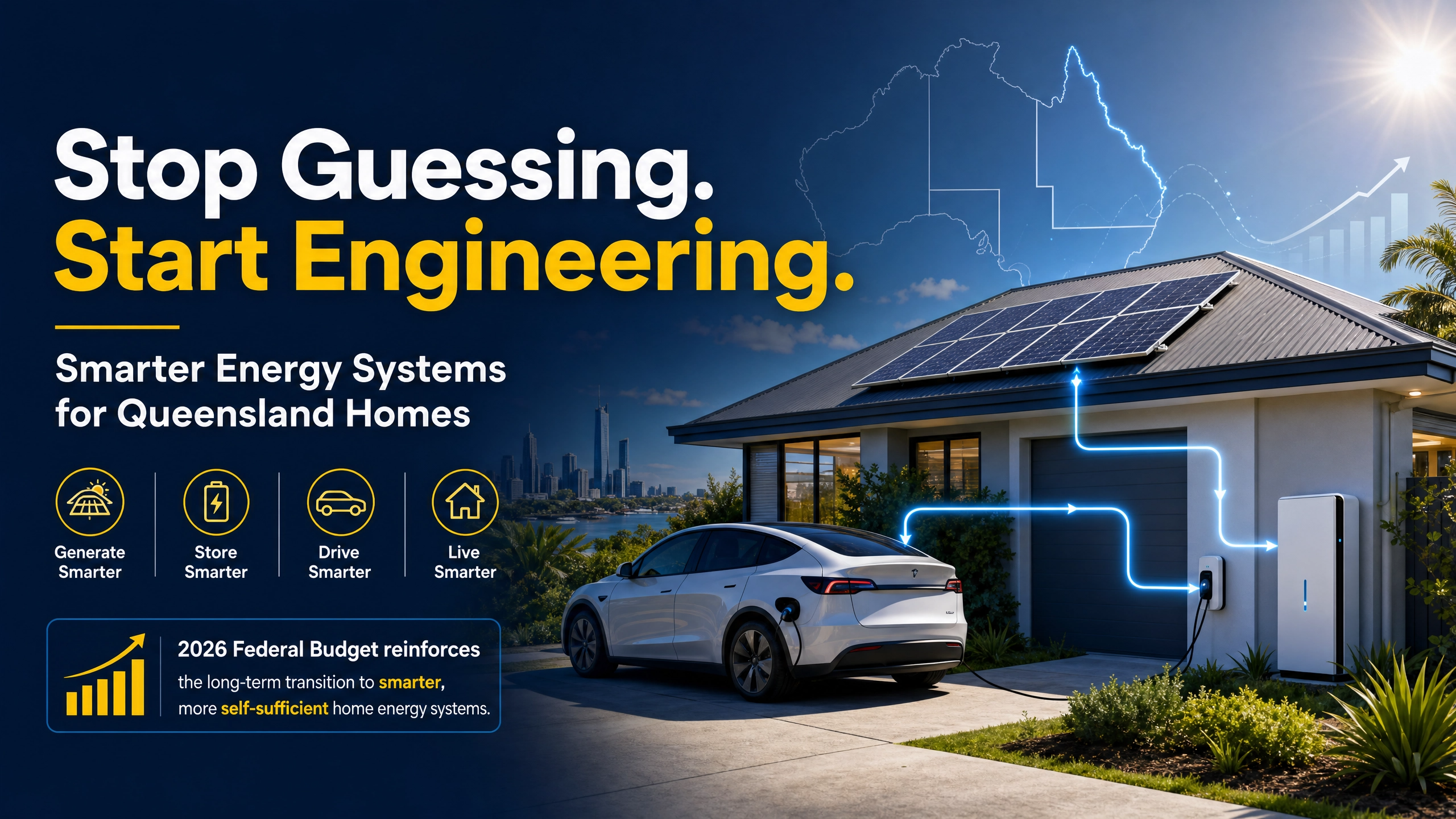
The release of the 2026 Federal Budget marks another important step in Australia’s long-term energy transition — not because of one dramatic new policy announcement, but because of what the budget continues to reinforce.
Rather than introducing short-term experimental programs, the Federal Government has doubled down on the broader direction Australia has already been heading toward: electrification, energy resilience, EV adoption, and household-level energy storage.
At Solar Surge Australia, we see this budget less as a “new beginning” and more as confirmation of a structural shift that is already reshaping the Queensland energy market.
For homeowners across Brisbane and the Gold Coast, one thing is becoming increasingly clear:
The future of residential energy is no longer just about generating power. It’s about generating, storing, and intelligently managing it.
1. The 2026 Budget Reinforces Australia’s Electrification Strategy
The 2026 Federal Budget further strengthens the government’s long-term commitment to household electrification and clean energy adoption.
Several key themes stand out:
Continued EV Tax Incentives: The extension of EV-related tax benefits signals continued support for electric vehicle adoption across Australia. As more households transition toward EV ownership, homes themselves are increasingly becoming “private fuelling stations” — powered not by petrol, but by rooftop solar and battery storage.
Ongoing Support for Battery Adoption: The budget also maintains momentum around existing battery and energy storage initiatives introduced in recent years.
This reflects a growing national focus on:
- reducing pressure on the grid
- improving household energy resilience
- supporting long-term energy security
Cost-of-Living and Energy Volatility: With energy costs remaining a major pressure point for Australian families, the budget places continued emphasis on managing household cost-of-living pressures. For many homeowners, this has accelerated interest in reducing long-term dependence on fluctuating grid electricity prices.
For Queensland households, the message is becoming increasingly practical rather than political: Battery-backed energy systems are rapidly becoming one of the most effective ways to future-proof household energy costs.
2. The “Feed-in Tariff Trap” Changing the Economics of Solar

One of the biggest shifts in the Australian solar market is the growing gap between what households earn from exporting power and what they pay to buy electricity back from the grid.
In many cases:
- excess solar exported during the day may receive around 5 cents per kWh
- electricity imported during peak evening periods may cost 30–40 cents per kWh
This pricing imbalance is reshaping how homeowners think about solar.
For years, the traditional “solar-only” model focused heavily on exporting unused power back to the grid. But as feed-in tariffs continue to decline, many homeowners are realising that storing energy is often becoming more valuable than selling it.
This is one reason battery adoption is accelerating across Queensland.
The conversation is no longer just: “How much solar can I generate?”
It is increasingly: “How much of my own power can I actually keep and use?”
3. Why the Future Is Moving Beyond “Solar-Only”

For the past decade, solar panel adoption was the primary focus of residential energy upgrades.
But the next phase of Australia’s energy transition is broader than solar generation alone.
The homes likely to benefit most over the next decade will be those capable of:
- generating their own energy
- storing excess power
- intelligently managing usage
- supporting future electrical demand
This becomes especially important as EV ownership grows.
An electric vehicle can dramatically increase a household’s electricity consumption. Without a properly designed energy storage strategy, many homeowners simply replace fuel costs with higher grid electricity bills.
A well-engineered battery system can help households:
- reduce peak-rate grid reliance
- support EV charging
- improve evening energy coverage
- increase resilience during outages or grid instability
In other words: The modern energy-efficient home is increasingly becoming an integrated energy ecosystem — not just a rooftop solar installation.
4. Why Engineering Quality Matters More Than Ever

As battery demand grows, the market is becoming increasingly crowded with sales-driven providers competing on price alone.
However, long-term energy performance is ultimately an engineering challenge, not simply a retail transaction.
System design, installation quality, monitoring capability, battery sizing, electrical infrastructure, and long-term support all play a major role in determining whether a system actually performs over time.
At Solar Surge Australia, our focus has always been on long-term system performance rather than short-term sales volume.
That includes:
- in-house electrical expertise
- dedicated installation teams
- 24/7 monitoring capability
- locally supported system management
For many Queensland homeowners, premium solar and battery systems are increasingly being viewed not simply as appliances, but as long-term infrastructure upgrades that improve both energy resilience and household efficiency.
5. The Bigger Shift Happening Across Queensland

The 2026 Federal Budget did not suddenly change the energy market overnight.
What it did do was reinforce the direction the market was already heading.
Across Queensland, more homeowners are beginning to recognise several realities:
- electricity prices are unlikely to become less volatile long term
- feed-in tariffs continue to trend downward
- EV adoption is accelerating
- household electrification is increasing
- energy independence is becoming more valuable
As a result, the conversation around solar is evolving.
The question is no longer simply: “Should I install solar?”
It is increasingly: “How do I build a smarter, more self-sufficient energy system for the next 10–20 years?”
That is the shift defining the next generation of Australian energy.
Stop guessing. Start engineering.
👉 Get Your 2-Min Free AI Energy Audit & Budget Rebate Check Now: